The Human Artist & Divergent Thinking

Updated: Aug 23

What is the Human Art School?
This article is a prelude to an art-based course offered at my studio, Redbrick Artspace and serves to inform prospective students and parents of my motivation and pedagogy [1]. This is a supplementary, non accredited short course that teaches art and design methodologies to students with low focus, mild dyspraxia [2] and common executive-function difficulties [3]. It's design is based on 17 years of teaching art & design modules in the higher education space (fig 1). Within my role of art specialist and educator I constantly researched more effective teaching methodologies and classroom strategies that would enhance student engagement, retention and performance. The Human Art School programme is the culmination of many years of research and is based on student interaction, lesson structure and the correlation with student performance and feedback. Whilst public and private institutes are constrained to a rigid 'one size fits all' curriculum model, I have taken a more student-centred approach.

Human Art School offers flexible, customised art sessions that meets the aptitude and creative aspiration of each individual. It aims to support scholastic life by developing conceptual and creative skills for students between the ages of 14 to 18 (grades 8-12) that can support executive-function difficulties. This refers to problems with how our brain processes, organises and regulates our behaviour in order to achieve our goals. I think of executive functioning as the brain's project manager, it helps you decide what to do, initiates doing, keeps track of what you're doing, and enables you to finish tasks. Someone can be highly intelligent and creative but still have difficulties with executive functioning, I have experienced these difficulties first hand within my private and professional life as well. In the classroom setting, I have observed that my students exhibit problems with task initiation, planning, organisation, working memory, time management, task switching, inhibition, emotional regulation and self-monitoring.
The number of students requiring special remedial interventions has grown substantially since I started teaching in 2009, it seems that changes in lifestyle and our proximity to technology has impacted our daily cognitive abilities. The clinical diagnosis we hear more often these days is neurodivergence [4] which includes the neurological profiles of ADHD, Autism, Dyslexia and other specific learning differences, Dyspraxia/developmental coordination disorder, Dyscalculia Tourette syndrome and some forms of executive-function difficulty. I am not a mental health professional and don't claim to have an in depth clinical understanding of neurodiversity, however as an educator I've had to provide support to my students struggling with these conditions. I therefore did some extensive reading, specifically on academic studies that outlined how art making methodologies could provide alternative modes of cognition through visualisation, experimentation, embodiment, materiality and sensory experience.
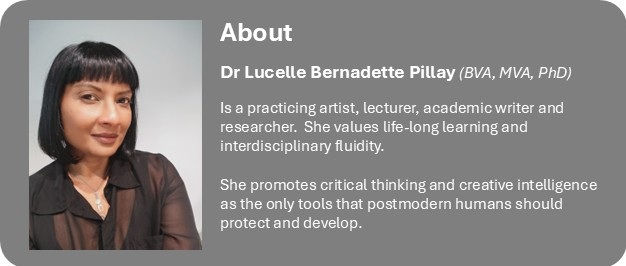
About Me
When planning teaching interventions I draw on my own experiences as a lifelong learner and student myself. I have studied alongside my career for over 20 years and have had to juggle the responsibilities of life and raising my daughter as a single parent. I understand the journey of the student and my own mental health challenges such as chronic anxiety, emotional dysregulation, post traumatic stress disorder and some mild traits of obsessive compulsive disorder. During critical times in my life I have sought therapy to achieve a sense of mental, physical and emotional balance, but have never been diagnosed according to the DSM [5], nor did I feel I need to label or categorise these conditions. However, within our family there is a history of bipolar and borderline personality disorder [6].
Most people of my generation group (Gen X) [7] have lived with various mental health challenges without knowing that that these are actual issues. Repressing emotions and adopting an attitude of 'Pick yourself up, dust yourself off and keep going' is an unspoken mantra I've come to observe in most of my Gen X friends and family. I've written about the trauma experienced by this generation group within the context of post-apartheid South Africa in my PhD thesis (Pillay 2026: 84) and have come to understand their deep seated fears and complexities, which are my own. The resilience and tenacity of my generation has served me well through times of environmental volatility and change but sadly I wasn't always emotionally present during my daughter's formative and teenage years. Looking back I realise I probably didn't acquire these tools from my parents as our family motivations were predominantly focused on work and economic survival. Using words like emotional vulnerability, depression or social angst were dismissed as excuses for not achieving success and I inevitably enmeshed these stoic attitudes within my child rearing.
Jodie Azalea
Research shows that most Gen X parents are adverse to therapy and only get diagnosed with certain mental or personality disorders late in life. This is often the result of group therapy with their child/ children who belong to Millenial and Gen Z groups [8]. My daughter, Jodie Azalea is a professional tattoo artist and entrepreneur living and working in the picturesque Hillcrest area in Durban. She has broken through into a very white, male dominated industry while ignoring all my warnings regarding pursuing higher education and the racial gatekeeping of certain niche industries. She has emerged as the youngest woman of colour to operate her own studio (Azalea Ink Tattoos) (fig 2) and boasts an impressive repertoire of designs and clients. However, her journey with mental wellness has been challenging, she has weathered many trying situations with dysfunctional family dynamics and fighting her own demons. Our relationship grew strained but with the help of therapy we were able to negotiate residual emotions, develop healthier coping mechanisms and heal through introspection.

I'm so proud of my daughter and her achievements in the face of insurmountable adversities, our roles have been reversed and she is now my teacher and advisor in most things. Human Art School is based on the life raft that both me and Jodie Azalea have in common, which is visual art. Art has always been our saving grace, as a child I always encouraged her to draw, paint and make things. Christmas and birthday gifts always included art materials and books on art techniques and I would like to believe that this offered her a means of self expression and identity formation. Jodie Azalea graduated from the National School of the Arts in Braamfontein and completed a year at The University of Johannesburg before undertaking tattoo art apprenticeships in Johannesburg and Durban. Although we live in different cities, we often collaborate on projects, she was instrumental during both my Masters and PhD exhibitions (Pillay 2026: 30). We both have used the medium of art to channel divergent thinking into the rigour of creative pursuits and I am hoping to help others to do the same.
The Ethos of Human Art School
During my time lecturing at various private institutes in Durban and Johannesburg I developed more flexible modes of teaching in order to improve student engagement and learning. These modes included how I organised the space, student seating and the combination of both traditional and digital mediums (fig 3). As digital tools became more ubiquitous in design schools, I developed the methodology of media-fluidity to enable students to transition from traditional tools to digital. Although the general assumption is that teenagers and young adults have a natural proclivity to wield mobile phones and navigate the internet, I have observed that this ability doesn't always translate effectively into the classroom.

The insertion of digitalism and AI within the art and design classroom can often have a negative effect on students, being faced with too many options and techniques. I often mitigate this by structuring lessons with clear conceptual and technical pathways. This enables a guided creative exploration within parameters, I tend to adapt and evolve methods depending on group dynamics and project outcomes. I can't take all the credit though as I have learnt as much from students as they have from me, I have never met a student that was a lost cause and I honestly believe that together we co-create knowledge in-situ.
Taking from classroom experience and ongoing research I developed a teaching model for Human Art School that would provide a more holistic approach to skills development. The programme focuses on the student’s areas of functioning (strengths) rather than attempting to classify them according to diagnosed or undiagnosed neurodivergent traits. Creative projects becomes a journey of self-discovery for those who may have been labelled as lazy, disruptive, incapable, unmotivated or antisocial when the underlying issue was actually an inhospitable learning environment and teaching approach.
Conventional academic education often privileges linguistic and sequential intelligence. Art education can provide alternative modes of cognition through visualisation, experimentation, embodiment, materiality and sensory experience. So instead of asking, "Can the student explain the concept ? I ask "Can the student show, construct, manipulate, perform or visualise the concept? This important pedagogical principle distinguishes Human Art School from other supplementary art courses. Group or partner projects can be particularly relevant to student’s who are socially reclusive. Social withdrawal should not automatically be interpreted as unwillingness to participate. It may reflect anxiety, sensory overload, previous negative social experiences, low confidence, difficulty interpreting social situations, or simply a preference for lower levels of social stimulation. Working collaboratively within the safe confines of a creative project may alleviate some forms of social anxiety.
What should you expect
I would need to screen prospective students in order to gauge their aptitude and creative motivations. This will entail a short meet and greet, to ensure the future client feels secure with me and the space before committing to scheduled sessions. Once onboard, I am able to facilitate a 1 hour weekly session to new students at my home studio. I would suggest a slow start so that students can become familiar with concepts taught and be able to balance deliverables with schoolwork. Students are allowed to schedule sessions as per their availability and can opt out of the programme at any time. Students may join group sessions after completing at least 3 months of consecutive weekly sessions.
As part of my ongoing research in this field I would request that my class observation and feedback notes be used to improve the course, be included in academic articles and thereby assist future students. Names and personal information will be anonymised and all data will be ethically applied, however students and parents are free to decline this request.
For more information please see Bookings & Enquiries below.
Important Disclaimers:
*This is an art-based educational course, not a form of psychological or clinical therapy. I am an artist and educator, not a psychologist or mental-health professional. The course is not clinically endorsed or intended to diagnose, treat, or prevent mental-health conditions. Participants seeking psychological support should consult a qualified mental-health professional.
*This course is a non-accredited educational programme and is not accredited by the South African Qualifications Authority (SAQA) or registered with the relevant South African education and training authorities. Completion of the course does not constitute a formal qualification or accredited certification.

Bookings & Enquiries for the Human Art School Programme
Email: lucellebernadette@gmail.com or Redbrick.artspace@gmail.com
Footnotes
[1] Pedagogy is the theory and practice of teaching and learning, including the methods, approaches, and principles used to facilitate learning.
[2] Dyspraxia is a developmental coordination disorder (DCD) that affects a person’s ability to plan, coordinate and perform physical movements. It can also affect aspects of organisation, sequencing, spatial awareness and processing.
[3] Executive function difficulties refer to problems with the brain processes we use to manage, organise and regulate our behaviour in order to achieve a goal. This includes:
Task initiation – being able to start something, even when you know what needs to be done.
Planning – deciding what steps are needed to complete a task.
Organisation – keeping materials, information and ideas in order.
Working memory – holding information in your mind while using it.
Time management – estimating how long something will take and managing deadlines.
Task switching – moving from one activity to another.
Inhibition – resisting impulses or distractions.
Emotional regulation – managing frustration, excitement, anxiety or disappointment.
Self-monitoring – recognising when something isn't working and adjusting your approach.
[4] Neurodivergence refers to variations in how a person's brain processes information, learns, communicates, regulates attention and responds to sensory or social environments.
[5] Diagnostic and Statistical Manual of Mental Disorders.
[6] Bipolar disorder is a mental health disorder characterised by significant shifts in mood, energy, activity levels, and ability to function. These shifts occur between periods of elevated or irritable mood and periods of depression. Borderline Personality Disorder is a mental health disorder characterised by a persistent pattern of emotional instability, difficulties in relationships, an unstable sense of self, and impulsive behaviour.
[7] Generation X generally refers to people born between 1965 and 1980. They are the generation between the Baby Boomers (1946–1964) and Millennials (1981–1996). Gen X grew up during a period of significant social and technological transition. A useful way of thinking about Gen X is that they are a bridge generation between an analogue childhood and a digital adulthood.
Gen X characteristics:
Childhood largely before the internet — television, radio, records, cassette tapes and landline telephones were dominant.
The arrival of personal technology — computers, video games, CDs and eventually the internet emerged during their adolescence and adulthood.
Greater cultural independence — often associated with self-reliance and a relatively sceptical attitude toward institutions.
Changing family and social structures — including increasing divorce rates and more dual-income households in many countries.
Major cultural shifts involving music, fashion, feminism, civil rights, globalisation and changing attitudes toward authority.
[8] Millennials generally refers to people born between 1981 and 1996. The exact dates can vary slightly depending on the source. Someone born in 1990 is generally considered a Millennial: they may remember using VHS tapes, landlines and physical encyclopedias, but also experienced the emergence of Google, Facebook, smartphones and streaming as they entered adulthood.
Generation Z generally refers to people born between approximately 1997 and 2012. The exact boundaries vary slightly between sources. They are often described as the first generation to grow up with digital technology, the internet and social media as an ordinary part of everyday life. A useful distinction is that Gen X largely experienced the transition from analogue to digital, whereas Gen Z grew up in an already digital environment. For an art or design context, this distinction can be particularly interesting: Gen Z's visual culture has been shaped by continuous image exposure, memes, short-form video, digital editing, gaming, AI and highly fluid online identities.
Important Links
Click on image below to read more about Azalea Ink:

List of References
Babhulkar, S & Deodhar, C. 2025. Case Study: Harnessing Art Therapy for Patients With Learning Disability. BJPsych Open: Jun 2011 (Suppl 1): S293–S294. doi: 10.1192/bjo.2025.10708.
James, SL. 2023. Neurodivergence and the Healing Potential of Art. The Drover Review. Volume VI (2013/2023).
Maslow, AH. 1943. A Theory of Human Motivation. Psychological Review 50 (4): 370-396.
Pillay, LB. 2026. A Dialogical analysis of 'Indian' South African identity and representation in contemporary visual arts, expressed through data-fluid narratives. PhD Thesis. https://ir.unisa.ac.za/handle/10500/32774.
Sinha, T. 2024. Inclusive Making: Learning to Design With and for Neurodivergence Through Participatory Making. The Barcelona Conference on Education. This work is published in the official conference proceedings (ISSN: 2435-9467, pages 845–859).
List of Figures
Cover Image. Lucelle Pillay, Artists at work (2026). Digital illustration.
Figure 1. Lucelle Pillay, Lucelle with art & design students at various private institutes (2023). Digital collage.
Figure 2. Jodie Azalea Pillay, Tyla Brassey's Octo-Skull (2024), Lucelle Pillay, Jodie Azalea in Session (2024). Digital composites.
Figure 3. Lucelle Pillay, Students working in Media-Fluid classroom at a private institute (2023). Digital photo.
Figure 4. Lucelle Pillay, Jodie Azalea (Tattoo Artist) (2024). Digital composite.


Comments