I visited REVERSE FUTURES at JCAF

Updated: Jul 31
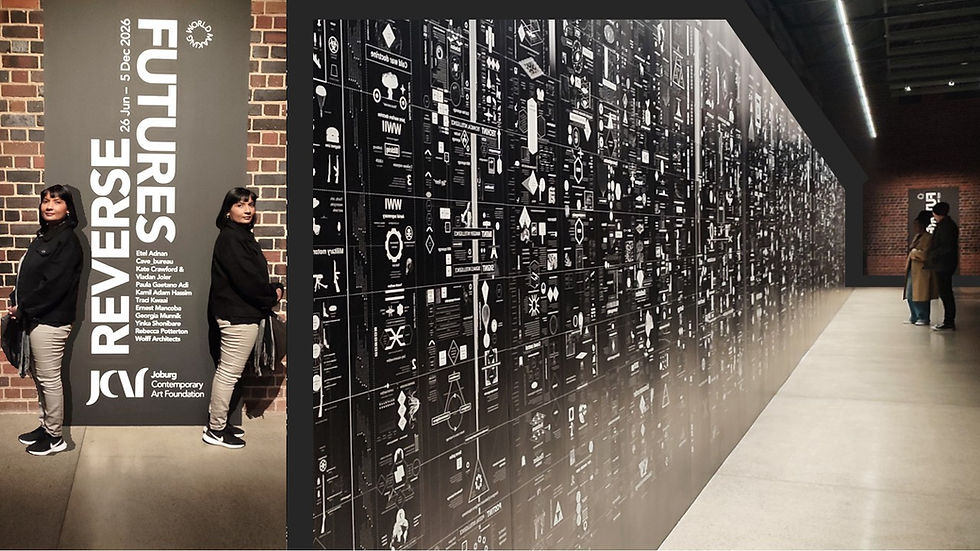
About JCAF
There are very few art events that would tempt me to venture outside on a weekend and brave July's icy winter spell. However, I couldn't resist the Johannesburg Contemporary Art Foundation's latest exhibition. Launched in 2020, JCAF celebrates their sixth year in the service of bringing art research and museum-quality exhibitions to the local community. This NGO is focused on conducting academic research and presenting exhibitions as an innovative approach to knowledge production in the Global South, "Our ethos is to advance the appreciation of modern and contemporary art through the production, sharing and preservation of knowledge from the South " (JCAF 2026). Having attended various exhibitions at JCAF since 2021, I can attest to the foundation's unerring commitment and delivery to their mission statement.
JCAF appeared on my radar early into my PhD research in 2020, they hosted the acclaimed Indian-American anthropologist, Arjun Appadurai, one of the most influential theorists of globalisation, culture, and transnational identity (Steinhardt 2026). At the time, Appadurai's theories on the postcolonial realities of minorities, specifically Indian diasporic people was a critical seminal source within my research of South African Indian identity. His speech, " The Planet, the Universe and the Museum: Territories of the Imperial Imagination" (2020) contextualised the systemic remnants of modernism and its implications within future geopolitics. Since their inception, JCAF has continued to host prominent speakers from various disciplines who promote the arts, culture and ethnographical research. Their endeavour to educate through discourse has certainly opened new conversations for me, by bringing these key global speakers to art communities within the locality of Johannesburg.
The foundation has become an invaluable platform and meeting place for artists, patrons and curators. It was at the interdisciplinary event, Pictures Reframed (2023) that I got to meet the Capetonian artist, Robin Rhodes. Intrigued by his intertextual narratives that seemed to oscillate between the mediums of photography, performance and film, I had followed his work for about 18 years. He chatted enthusiastically with me about the exhibition, Edge of the Centre (2005), that was featured in the publication, Art South Africa. I opportunistically carried my vintage copy along which Rhodes graciously signed (see figure 1), I was thrilled to add it to my collection and grateful to JCAF for facilitating this engagement.

In December 2023 the launch of, JCAF Journal: Interdisciplinary Knowledge from the South, was the culmination of three years of research. This inaugural event was highlighted by a screening of Rhode's multidisciplinary work, Pictures Reframed which was accompanied by Qden Blaauw's live rendition of Russian composer Modest Mussorgsky's classical piano suite, Pictures at an Exhibition (Hanmer 2024). This layered performance of visuals and music was hauntingly melancholic, exuding deeply nuanced themes of existential angst and human endurance. Zada Hanmer (2024) commented, "The decision to include this work as part of the JCAF Journal's launch demonstrated a commitment to championing art-centred knowledge systems. The journal and the methodology behind it have the potential to change the fabric of our existing knowledge production systems, particularly those in academia, which remain largely closed off from public access." This academic and artistic closed off-ness has been the legacy of the previous era of exclusion and is thankfully what JCAF mitigates within the contemporary visual arts space.
REVERSE FUTURES

This exhibition marks the close of the foundation's Worldmaking series and focuses on ideations of the future from the perspective of the Global South, where past, present and future are intertwined. " Grounded in historical research, artists’ lived experiences, community narratives and Indigenous knowledge systems, the exhibition examines how the effects of colonialism, migration and technological change continue to shape both the present and our visions of what lies ahead " (JCAF 2026). Reverse Futures seems to be the perfect conclusion to this guided journey of our collective imaginings as we brace for a future of global uncertainty and unprecedented technological and climate change. In retrospect, the previous Worldmaking exhibitions, Otherscapes (2023), Ecospheres (2024) and Structures (2025) holistically map an ethnographic narrative of humans navigating their socio-geographic realities in a time of the anthropocene [1].
My review of the exhibition is based on my own meanderings, ponderings and associations that I bring to the space. Although much of my career entailed the academic study of genres, historiography and the theory that underpins artmaking, I still attempt to view artwork with a sense of childlike awe and naivety. This is facilitated by JCAF's impeccable yet unimposing curation, the dimly lit space provides an almost theatrical juxtaposition of visual narratives in a meticulously considered sequence that beckons the viewer. I strongly advise those readers who are new to art appreciation to merely bring a sense of curiosity, openness and your own experiential knowledge to the works on display, this is enough. A predetermined knowledge will not prepare you for the surprising and opportune moments that present themselves within the gallery, for instance Yinka Shonibare's Refugee Astronaut X (2024) viewed against Kate Crawfords & Vladan Joler's expansive data visualisation (see figure 2). I'm reminded how Western technological progress plays out in divergent ways in the global South. This concept was underpinned by the beautiful interplay of coded symbols, the gridded black and white text contrasted against the organic print of the Dutch wax fabric.
Shonibare is a British-Nigerian interdisciplinary artist whose work reflects on themes of colonialism and global trade between Europe and Africa. Her nomadic astronaut travels through space with a survivalist backpack consisting of a compass, binoculars, a hat, pans, rope and a Malagasy board game. This reminds me of Subodh Gupta's, Untitled (2012), a hoisted wooden boat filled with utilitarian objects collected from the ancient trade fort of Kochi in Kerala. Exhibited at India's first global biennale, the Kochi-Muziris [2], Gupta's work, presented within the space of a former shipbuilding yard, becomes a symbol of migration, movement and cultural exchange (D’Souza 2013:307). Note the similar themes applied by the artists of African and Indian descent as they confront notions of postcolonial displacement and existentialism.
![Figure 3a. (left) Yinka Shonibare, Refugee Astronaut X (2024). Fibreglass sculpture - Figure 3b. (right) Subodh Gupta, Untitled (2012). Mixed media installation [Note: This artwork is not part of Reverse Futures]](https://static.wixstatic.com/media/dd35fe_4f5a9db1dc8142f9af07ed6f6620d83a~mv2.jpg/v1/fill/w_980,h_419,al_c,q_85,usm_0.66_1.00_0.01,enc_avif,quality_auto/dd35fe_4f5a9db1dc8142f9af07ed6f6620d83a~mv2.jpg)
Researchers Crawford's & Joler's Calculating Empires: A Genealogy of Technology since 1500 (2023) (fig 4) was by far one of my favourite artworks, its impressive scale extended the full length of the gallery. This collaboration brings data investigation, critical cartography and visualisation to the foreground of artistic endeavour. JCAF (2026) states that the work "...is a large scale visual manifesto created to highlight the relationship between technology and systems of control over the last five centuries". These themes are very pertinent as the insurgence of AI creeps into every aspect of our public and private lives. I work conceptually with data in my art practice and found this piece both immersive and deeply engaging. It was impossible to read the entire grid, but I did capture a few interesting details (fig 5). This artwork skillfully employs static data visualisation as a powerful storytelling device that provides us a bird's-eye view of 500 years of human technological development.


Rebecca Potterton's series of 30 digital illustrations, Remembering Tomorrow (2026) (fig 6a) "depicts human rituals, practices and objects that carry us forward" (JCAF 2026). Her totemic structures speak to the more ancient iconography of ancient civilizations. Like language, Potterton suggests that our past informs our future, we leverage our collective material culture against our future imagineerings. I was humbled to view Ernest Mancoba's Untitled (1971) (fig 6b) abstract in situ, vibrant sketchy brush strokes set against a pale cream backdrop. Mancoba left South Africa in 1938 to study at Ecole Nationale Superieure des Arts Decoratifs de Paris, He did not originally intend permanent exile, but the outbreak of the Second World War, his internment by the Germans, and his subsequent marriage to Danish sculptor Sonja Ferlov meant he remained in Europe. Mancoba returned to South Africa in 1994 at the age of 90, a retrospective of his work entitled Hand in Hand, was curated by Elza Miles at the Johannesburg Art Gallery (Hardy & Thomson 2025).
Mancoba's life's journey straddles African cosmology and Western modernism, in his search for "a universal artistic language through abstraction" (JCAF 2026). He reminds me of a spiritual nomad, perpetually exiled yet seeking refuge like Shonibare's astronaut. His muted umber palette and energised brush strokes seem to capture something from our primal past, juxtaposed with the more recent Satellites 27 (2020) by Etel Adnan (fig 6c) it opens a conversation with the present. Adnan too was somewhat of a cultural nomad, affected by the war in the Middle East, she moved between Lebanon, France and United States (JCAF 2026). Her seclusion during the COVID pandemic resulted in the Satellite series, in which she focused on celestial bodies and space. The pink hues are reminiscent of the quality of light in the capital city of Beirut, the discs represent planets, the moon and sun. At the close of her life, the artist perhaps found comfort in these soft-edged orb-like forms as she cast her eyes to the sky and the otherworldly. Note that these three artworks are not exhibited as a group in situ, I just thought they spoke well to each other, do you agree? Let me know your thoughts in the comments.

Cave_Bureau is a Nairobi-based group of artists, architects and researchers exploring how architecture can help address social and ecological challenges in local communities in Kenya (JCAF 2026). I was awe-struck by how this interdisciplinary collaborative applies the geological and speleological [3] data of the Shimoni Slave Cave (2022-2023) (fig 7a) to present this dramatic data visualisation. In the 19th century, the site was used to temporarily hold people before feeding them into the East African slave trade. The massive artwork was created from 3D renderings and laser scans of the actual cave to the scale of 1:1. The organic, undulous surface was formed using Kagome triaxial weaving technique, which can be traced to Japanese basket weaving. The intricate natural rattan formation is beautiful and appears like a honeycomb formed by bees, it is presented with a 1:1000 model of the Shimoni cave and a film entitled, Anthropocene Museum 2.0: Shimoni Slave Caves (2021) (fig 7b). The ancient geographical cavern becomes a time capsule holding a spatial memory of early civilisation and the trauma of colonialism at its most brutal. JCAF's conceptual underpinning of reverse engineering our future becomes apparent here. As an artist I would love to work on a similar data project of this scale and nature where science and art segues into an epic human narrative, told in a vernacular that only this union can bring.

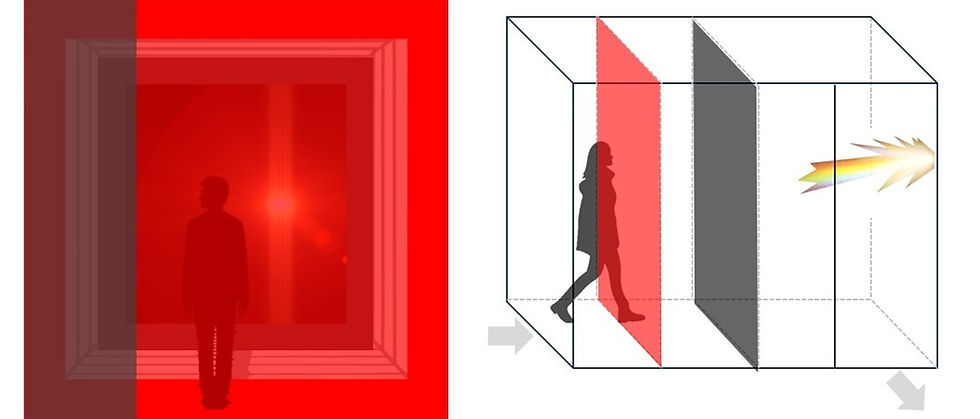
Kamil Adam Hassim [4] is a transdisciplinary artist drawn to the concepts of space and time (JCAF 2026). The artist uses indigenous methods of navigating space and time, such as Polynesian wayfinding, to explore the connections between cultural paradigms, information flows and ways of interfacing with the cosmos (JCAF 2026). I found the immersive installation, Event Horizon (2026) (fig 8) recreates the environment of a moonless night in the Karoo Desert. I found the experience both disarming and visceral, as I entered the first chamber I was plunged into a vermilion glow which drained my vision of all colour. The red light without warmth felt unnaturally comforting before I entered the adjoining chamber and was plunged into inky blackness. At the loss of my immediate environment, I resorted to the sensory refuge of my own body, aware of my breathing and trying to remember my orientation to the greater space of the gallery. The air thickened with a type of smoke I couldn't identify, as I entered the third and final chamber my eyes had little time to adjust to a flashing, disorienting strobe light. I was surprised that my initial reaction was to recoil to the previous chamber, but soon found the exit. The overall experience was intriguing if not a bit discombobulating, I have created 2 diagrams (fig 9a & 9b) to give you a better understanding of the installation.

Paula Gaetano Adi is an Argentine artist working across robotics, sculpture and performance. She proposes and alternative to models of technological innovation rooted in violence, oppression and exploitation (JCAF 2026). The robot, Guanaquerx (2024) (fig 10) is based on the native Guanaco and a mythical guardian creature of the Andes. Anything but sleek, the robot is a cobbling together of machinery, colihue cane and Andean cloth. I'm reminded again of Refugee Astronaut X clad in Nigerian Dutch wax, these indigenous textiles implicate the non-Western identity within Western technological progress. The documentary that plays on loop shows a group of humans and Guanaquerx reenacting the crossing of the Andes, a symbolic event representing political independence in parts of South America. Post apocalyptic scenes project forward to a possible coexistence with human and non-human entities. Gaetano Adi alludes to a form of Posthuman mutualism in her imagined futurity.

The artist Georgia Munnik works with the medium of scent as a conduit to unpacking ourselves and our environments. Her art becomes a form of olfactory practice and an exploration of the binary themes of life and death, beauty and decay, growth and decline (JCAF 2026). Munnik crafted a bespoke scent, Concrete Jasmine (2026), a sensorial ode to the city of Johannesburg, a mix of pink Jasmine and damp concrete. Infused into cast-resin flower heads, The Strangling Fruit (2026) exudes the ugly beauty of the derelict city, where humans struggle for survival. Similarly Tracy Kwaai presents the plight of the displaced fisher-families of Kalk Bay, their livelihoods threatened due to restricted access to marine resources (JCAF 2026). The interactive artwork, Fisher Child (2025) can be experienced via a Virtual Reality (VR) headset, immersing the viewer in an oceanic ether of sound and images. Kwaai co-created the narrative with community members, by embedding it within a technological medium of VR she future-proofs their history, heritage and identity.

I hope my somewhat long meander through the gallery space has been informative and sparked your interest in human pasts and how it foreshadows the future. The participating artists have conceptualised sensorial experiences and visual narratives that reflect our collective colonial trauma's, our resilience and our hope for a future of potentialities. Special thanks to the gracious and knowledgeable Guides (fig 12) who informed patrons and provided context.

Footnotes
[1] Anthropocene is a proposed geological epoch that describes the period in which human activity has become the dominant influence on Earth's climate, ecosystems, geology, and environment.
[2] The Kochi-Muziris Biennale is an international contemporary art exhibition held every two years in Kochi, Kerala, India, that brings together artists from around the world while engaging with the region's rich cultural, historical, and maritime heritage.
[3] Speleogenesis – the formation and development of caves.
[4] Kamil Adam Hassim is the youngest recipient of a residency at the European Organisation for Nuclear Reasearch (CERN).
Import Links
Ecospheres at JCAF: Worldmaking https://www.lucellepillayart.co.za/post/ecospheres-at-jcaf-worldmaking
JCAF Presents ‘OTHERSCAPES’: Four Installations by Four Contemporary South African Artists https://www.lucellepillayart.co.za/post/jcaf-presents-otherscapes-four-installations-by-four-contemporary-south-african-artists
JCAF Presents: Women Artists of the Global South https://www.lucellepillayart.co.za/post/jcaf-presents-women-artists-of-the-global-south
JCAF Website https://jcaf.org.za/exhibitions/reverse-futures/
List of References
D’Souza, RE. 2013. The Indian biennale effect: the Kochi-Muziris Biennale 2012, in Cultural Politics 9 (3):296-312. https://read.dukeupress.edu/cultural-politics/article/9/3/296/25931/The-Indian-Biennale-EffectThe-Kochi-Muziris (Accessed 9 November 2025).
Hanmer, Z. 2024. Interdisciplinary methods: JCAF Journal and Robin Rhode's Pictures Reframed. https://artthrob.co.za/2024/04/24/interdisciplinary-methods-jcaf-journal-and-robin-rhodes-pictures-reframed/ (Accessed 7 July 2026).
Hardy, P & Thompson, B. 2025. Ways of Seeing. Mancoba's Art. Johannesburg: University of Johannesburg and Art and Ubuntu Trust Cape Town. chrome-extension://efaidnbmnnnibpcajpcglclefindmkaj/https://ujonlinepress.uj.ac.za/index.php/ujp/catalog/download/488/1415/6498?inline=1&utm_source=chatgpt.com (Accessed 30 July 2025).
JCAF. 2026. Johannesburg Contemporary Art Foundation. https://jcaf.org.za/exhibitions/reverse-futures/ (Accessed 7 July 2026).
NYU, Steinhardt. 2026. Arjun Appadurai, Professor Emeritus. https://steinhardt.nyu.edu/people/arjun-appadurai (Accessed 7 July 2026).
JCAF Reader. 2026. Reverse Futures. Printed copies provided by gallery.
School of the South. 2020. The Planet, the Universe and the Museum: Territories of the Imperial Imagination, presented by Arjun Appadurai.
Pillay, LB. 2025. A DIALOGICAL ANALYSIS OF ‘INDIAN’ SOUTH AFRICAN IDENTITY AND REPRESENTATION IN CONTEMPORARY VISUAL ARTS, EXPRESSED THROUGH DATA-FLUID NARRATIVES. PhD Thesis. https://ir.unisa.ac.za/handle/10500/32774 .
List of Figures
Cover Image. Reverse Futures (2026). Composite digital image. Photos: Lucelle Bernadette Pillay.
Figure 1. Robin Rhodes featured in signed copy of Art South Africa publication (2005). Digital composite. Photos: Lucelle Bernadette Pillay.
Figure 2. Front view of Yinka Shonibare's Refugee Astronaut X (2024) against the backdrop of Kate Crawfords & Vladan Joler's Calculating Empires: A Genealogy of Technology since 1500 (2023). Digital photo: Lucelle Bernadette Pillay.
Figure 3a. (left) Yinka Shonibare, Refugee Astronaut X (2024). Fibreglass sculpture. Dutch wax fabric, net, possessions, astronaut helmet & moon boots. Courtesy Collection Foundation H. Copyright Yinka Shonibare. Image courtesy of Yinka Shonibare & Goodman Gallery, Cape Town, Johannesburg & London. Photo: Stephen White & Co. Source: JCAF Reverse Futures Reader.
Figure 3b. (right) Subodh Gupta, Untitled (2012). Mixed media installation [Note: This artwork is not part of Reverse Futures]. Found miscellaneous objects in hoisted wooden boat. https://www.architecturaldigest.in/magazine-story/behind-scenes-kochi-muziris-biennale-2016/ (Accessed 19 February 2025).
Figure 4. Kate Crawford & Vladan Joler, Calculating Empires: A Genealogy of Technology and Power since 1500 (2023). Digital photo: Lucelle Bernadette Pillay.
Figure 5. Kate Crawford & Vladan Joler, Calculating Empires: A Genealogy of Technology and Power since 1500 (2023), Close-up details. Digital photos: Lucelle Bernadette Pillay
Figure 6a. (left) Rebecca Potterton, Remembering Tomorrow (2026). Digital illustrations. Copyright Rebecca Potterton. Source: JCAF Reverse Futures Reader.
Figure 6b. (centre) Ernest Mancoba, Untitled (1971). Oil on linen. Private Collection. Copyright & courtesy of Ferlov Mancoba Foundation/ Galerie Mikael Andersen. Source: JCAF Reverse Futures Reader.
Figure 6c. (right) Etel Adnan, Satellites 27 (2020). Oil on canvas. Private Collection. Copyright Etel Adnan/ DALRO. Image courtesy Galerie Lelong & the Estate of Etel Adnan. Source: JCAF Reverse Futures Reader.
Figure 7a. (left) Cave_bureau, Shimoni Cave (2022-2023), Installation.
Figure 7b. (right) Close-up details. Digital photos: Lucelle Bernadette Pillay.
Figure 8. Kamil Adam Hassim, Event Horizon (2026). Cosmic detection instrument. Interactive installation. Copyright & courtesy of Kamil Adam Hassim. Source: JCAF Reverse Futures Reader. Digital composite: Lucelle Bernadette Pillay
Figure 9a. Diagram of immersive installation, Event Horizon (2026). Front view. Digital illustration: Lucelle Bernadette Pillay
Figure 9b. Diagram of immersive installation, Event Horizon (2026). Side view. Digital illustration: Lucelle Bernadette Pillay
Figure 10. Paula Gaetano Adi, Guanaquerx (2024). Digital photo: Lucelle Bernadette Pillay.
Figure 11a. (left) Georgia Munnik, The Strangling Fruit (2026). Mixed media. Resin, Hario filters, black obsidian and citrine crystal shards, lemon verbena tincture, tree moss tincture, synthetic cannabis raw material (scent molecules), oxidised copper residue, copper pigment, gold pigment, brown shimmer eyeshadow, coffee residue, honey & rose fermentation residue, saffron absolute, dragon pea flower tea & thyme essential oil, oxidised brass lamp fitting & unique hand-cast lamp holders. Copyright & courtesy of Georgia Munnik. Photo: Slater studio, courtesy Whatiftheworld. Source: JCAF Reverse Futures Reader.
Georgia Munnik, Concrete Jasmine (2026). Bespoke olfactory scent. Courtesy of the artist.
Figure 11b. (right) Traci Kwaai, Fisher Child (2025). Still from VR installation. Copyright & courtesy of Traci Kwaai in collaboration with Kylie Marais & Lo-Def Film Factory.
Figure 12. Exhibition Guides. Digital composite: Lucelle Bernadette Pillay.


Comments